Consciouscarma
  • Home
  • About Us
  • Products
  • Community
    • Campaigns
    • Inspiration
    • Initiatives
    • CSR
  • Features
    • Sustainable Startup Stories
    • Travel
    • Lifestyle
    • Partners
  • Economy
    • Industry
    • Innovations
    • National
    • Global
  • Environment
  • Expert Corner
    • Authored Articles
    • Reports
  • Magazine
  • Contact
Category:

Travel

Eco-friendly and sustainable destinations, preserving  the natural flora and fauna, using local resources and benefitting the region economically and socially

Travel

ITC’S THREE LEED ZERO CARBON-CERTIFIED HOTELS CREATE GLOBAL MILESTONE

by Team Conscious Carma June 3, 2022
written by Team Conscious Carma

~Experience ITC Hotels’ timeless spirit of innovation #LoveNatureLivezero~
Delhi, June 3rd , 2022- Reaffirming its credo of ‘Responsible Luxury’ with a comprehensive focus on sustainability, health and hygiene, ITC Hotels is proud to announce that 3 of its properties in India have been ranked as the world’s top 3 LEED® (Leadership in Energy & Environmental Design) Zero Carbon certified hotels, a first-of-its-kind achievement globally.

ITC Windsor, Bengaluru, became the 1st hotel in the world while ITC Grand Chola is one of the largest hotels in the world to have received theprestigious LEED Zero Carbon Certification. ITC Gardenia has become the third hotel in the world to receive the certification. 

LEED Zero Carbon recognizes buildings operating with net-zero carbon emission and LEED® Platinum is the highest rating awarded by U.S. Green Building Council (USGBC). ITC Hotels is the world’s largest chain with the maximum number of LEED Platinum Certified Properties as per USGBC.

From using renewable energy and recycling solid waste to conserving water, actively mitigating   single use plastic and reducing the carbon footprint at every step, ITC Hotels have been delivering luxury experiences with planet positive offerings embedded in product, processes, people & progress. Over 40% of consumable food materials used at ITC Hotels is sourced locally and the properties have adopted infra-red based efficient cooking in kitchen leading to near 20% energy savings.

Living upto its promise of ‘Responsible Luxury’, ITC Hotels launched a path-breaking“WeAssure”programme, adopting highest standards and protocols in health, hygiene, safety and infection control management. For this initiative, ITC Hotels became the first hotel chain in the world to receive Platinum level certification under DNV’s My Care Infection risk management programme. In addition, the hotel group introduced waste segregation methods to achieve more than 99% waste recycling and also pioneered mitigation ofsingle use plastic.

Anil Chadha, Divisional Chief Executive, ITC Hotels, stated, “ITC Hotels is committed towards sustainability and consistently works to achieve its vision of offering patrons an experience of ‘responsible luxury’. We pride ourselves on the milestones that we have achieved in our endeavour towards contributing to the Planet. Three of our luxury properties have put India on the global stage by being recognised by LEED as Net Zero Carbon Certified hotels. This achievement is not ours alone but of all our associates and guests who believed in us and shared the same value system. I would like to acknowledge the efforts of ITC Hotels in ensuring that we preserve the elements of sustainability. We shall continue in this direction with our promise to Mother Earth.”

All ITC Hotels have organic waste converters with most of them being equipped with Onsite Bio- Methanation plants. The group has reduced the fresh water consumption by almost 50% with strategic conservation, treatment and reuse over the last 5 years. 57% of electrical consumption at ITC Hotels & Welcomhotels is met through renewable sources. These include ITC Grand Chola, ITC Windsor, ITC Gardenia, ITC Maratha, ITC Grand Central, ITC Mughal, Welcomhotel Chennai, Welcomhotel Coimbatore, Welcomhotel Bengaluru and Welcomhotel Sheraton New Delhi, which are powered by renewable electrical energy. ITC Hotels’ current carbon emission level is at 61 kg per overnight guest stay and 58 kg per sqm per annum against the 2030 target of 65 kg and 129 kg respectively. These milestones have been accomplished through implementation of various renewable energy and energy efficiency initiatives.

Some of the pioneering eco-friendly initiatives of ITC Hotels are highlighted below:

  • The design of every ITC Hotel is based on Green Building guidelines and standards which are energy efficient, utilize renewable energy, conserve and recycle water while taking concrete steps to preserve the eco-system around them.
  • The hotels have witnessed up to 20% increased efficiency with the installation of a programmable HVAC (Heating Ventilation and Air Conditioning) control called the Automated BMS System
  • Key sustainability initiatives are executed in identified hotels. They include in-house production of water with the help of atmospheric water generator, rainwater harvesting, day light harvesting, solar heating, food waste composting, biogas generation and   switchover from HSD/biodiesel fired boilers to renewable electrical energy based boiler for steam application.

All ITC Hotels and Welcomhotels are ISO 14001 Environment Management System and ISO 22000 Food Safety Management Certified. ITC Kohenur has received the 5-star Green Rating for Integrated Habitat Assessment (GRIHA) for incorporating various sustainable practices in building design & operation. ITC Sonar is the only hotel in the world to earn carbon credits under the UNFCCC (United Nation Framework Convention on Climate Change) Kyoto Protocol’s Clean Development Mechanism.

All ITC Hotels & Welcomhotels have implemented COVID Mitigation in Conditioned Spacein its HVAC system. The advanced oxidation patented technology neutralizes indoor air pollutants, bacteria and viruses. This technology cell creates photo hydro ions and destroys more than 99% of microbes present in the conditioned space. It is an active technology, where the ions neutralize every airborne organic contaminant it locates.

ITC Hotels is also committed to supporting local artisans while reviving and popularising ancient cuisines and is actively engaged in keeping alive India’s time-honoured rituals that promote well-being. WelcomArt, WelcomJawan, WelcomTheatre, Responsible Dining through Local Love, Eat Wisely and Food Sherpa are some of its signature programmes that have defined Responsible Luxury.

About ITC Hotels:

ITC Hotels is the largest chain of hotels in the world, which has the maximum number of LEED Platinum Certified Properties (as per USGBC on June 2020, ). Continuing with its Planet Positive Promise, ITC Hotels launched Sunya Aqua or zero-kilometre water in glass bottles across the chain over a decade back and have taken this lead further and pioneered the mitigation of single use plastic from its operations pan India.

For more information, please contact ITC Hotels
Richa Sharma, 98105 27474
June 3, 2022 0 comment
0 FacebookTwitterPinterestEmail
Travel

Be water wise – The water story of Grape Country Eco Resort

by Team Conscious Carma May 18, 2022
written by Team Conscious Carma

By Freeda Maria, Consulting Editor – Sustainable Tourism, Conscious Carma, As I write this piece for a story on how a barren land, touched by rough summers can be replete with water, all year round. I am reminded of the quote from the famous Amol Palekars’ Hindi film, “Thoda sa Romani ho jaye” wherein ‘Barishkar’ played by Nana Patekar speaks about water (jal).  What better way to emulate the dialogues and the strong scenes that invokes the activist in ‘Barishkar’? He promises to bring rain in a drought affected area for 5000 Rupees. And while asked by a man, if it was real water, his stellar response, shook the audience and created history.  It seems rather impossible to get such a feat of a job done, but there seem shocking stories of how people who did it.
The water story of Grape County is nothing short of a similar effort.
As I sit by the “Deck” (The restaurant of Grape County Eco Resort) and look around I see yonder that it’s not a terrain to have water all-round the year. The summers can get very harsh, dry, and with heat waves hitting you hard.

Read on to know, of the many concerted efforts and the pains to get perennial waters to the confines of Grape County Eco Resort

The picture says it all. as we look around the landscape is different from the green patch of GC
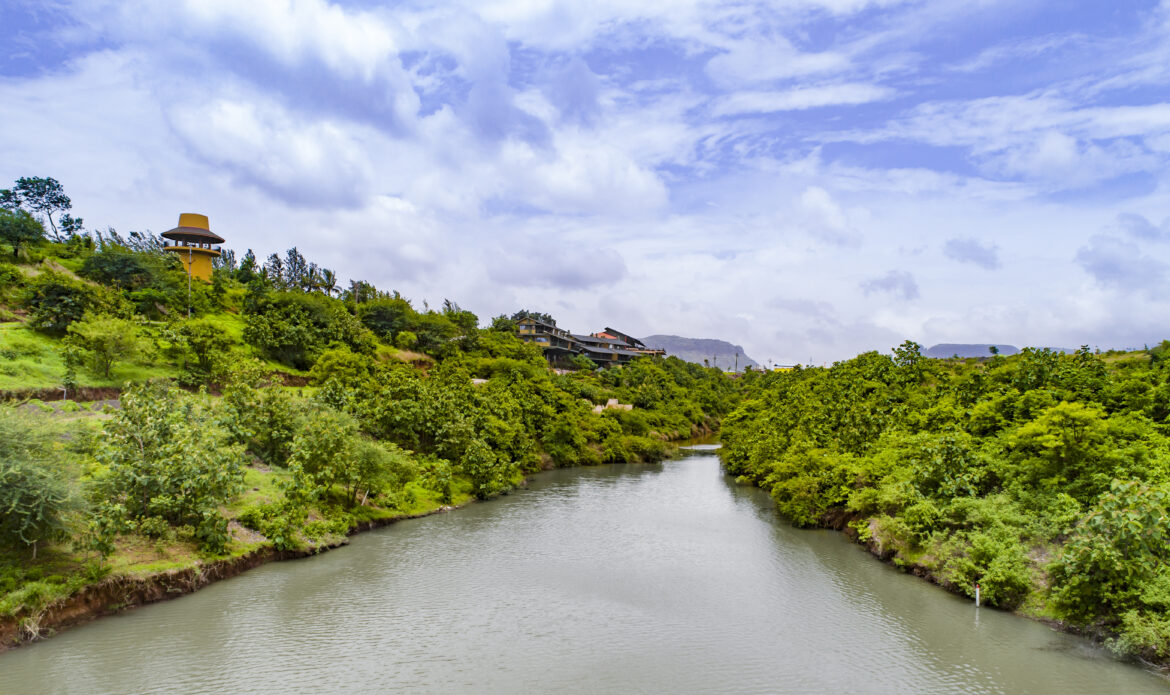
Extracted from map carta on 13/04/2022, you will notice the large lake and the greenery of GC.
(source: https://mapcarta.com/Grape_County_2611173/Map)

Synergy has been created to fetch, conserve and preserve water. A well thought through system with months of research; gradient catchment from one pond to another allows filling up of all the ponds and lakes. The resort is almost tucked on slopes, with a stream skirting along one side of the boundary and roads winding through its undulating landscape. Focal points have been identified to allow digging of underground land for water to seep through and remain stored. Connecting mouths and the watershed systems are woven beautifully well, as seen the pictures if you look carefully.

The lake, the lifeline of Grape County Eco Resort

Water has a deep connection to the vision of our place, “Vasudaiva Kutumbhakam” “where all elements of nature co-exist peacefully and interact joyfully”, quotes the Chairman of Grape County Eco Resort, Kiran Chavan.

Its not always green, a lot of efforts go into making it one. the Director Mr Tejas (Left) at the site during construction days

He adds further, “The rivulet formed a natural source, that was vital for us, we had to keep it perennially water fed and that took care of our water system and our requirement.”

As I continue my conversation with the visionary Mr. Chavan, he relived every moment of their water story and explained vividly the process. “The landscape made it easy,” he says, “we planned to capture rainwater through four phases; in the hills, in the valleys, the plains and through planting of saplings/trees.”  My inquisitiveness rose, my ears grew more alert and the mind couldn’t wait to listen. Mr. Chavan mentioned, rainwater falling on the hills, was collected through the making of contours; which otherwise would ensure the water would run off.”  “The beauty of application of the technique running water must be made to walk, walking waters must be made to stand and the standing waters should be made to enter the sub soil and recharge the water table!” What an enamour.

Check dams were built to capture and store water in the valleys of this landscape and in the plains connecting ponds were dug, if one filled up the other would automatically fill to the brim. Though the distance of the ponds were not close to each other. Nature took course and acted the way it needed to. The most important of all the phases was the planting of 45,000 saplings/trees, the rainwater that falls on the leaves travels through the stem to reach the roots and remains there to reach the aquifers and recharge the water table.

And I pen down the thoughts of Mr. Tejas Chavan, Director and future torch bearer of the future of Grape County Eco Resort, “The most precious resource in today’s time is Water. It is our responsibility to conserve it for future generations. I wish everyone does take some small steps or big leaps towards this effort”. The Lakes at GC, the Bada Talaav (Big Lake), and two Chota Talaavs’ (Small lakes) in the plains store almost 21,000 crore litres of water! Where is the need to depend on outside sources?

Water is Vital, it gives life to a place. The fluid element has healing properties. I see and feel that vibration here at Grape County Eco Resort. As I finish writing this piece, I walk through this terrain to find the lakes full of water, the trees brightly coloured green and the birds singing and dancing to their tunes…a voila we are in the peak of summer.

Grape County is Replete with Water!
To know more, log on to www.grapecounty.in
The article is published in collaboration with Grape County.

May 18, 2022 0 comment
0 FacebookTwitterPinterestEmail
Travel

Wrap-up 2021, Sustainable Tourism A two-year tough period, of a pandemic that stooped in like an apocalypse, invoking the highest levels of uncertainty in the minds of people

by Team Conscious Carma January 21, 2022
written by Team Conscious Carma

By Dr. Freeda Maria

2022 looked promising as people were contemplating little respite, to travel and see some normalcy, with fingers crossed!

But to dire dismay, the news of the third wave of Omicron, the tourism industry will probably have to wait for a comeback like the pre-pandemic times. What everyone is left with is an obvious choice to undertake conscious travel; options that throw good sustainability standards.

The World Tourism and Travel Council (WTTC) reported that in 2020 a total of 62 million jobs were lost, representing a drop of 18.5% and leaving just 272 million (334 million in 2019) employed across the Tourism sector globally. WTTC also confirmed that Domestic visitor spending decreased by 45%, while international visitor spending went down by 69.4%.  

From dismal statistics that were being strewn, there was still hope for the Travel, Tourism and Hospitality (TTH) business, for the Ministry of Tourism, Government of India, (MoT, GoI), had come out with schemes that had one of the best intentions of quality tourism promotion; besides in-bound, the focus was on Domestic Tourism.

To boost domestic Travels, the Government had introduced some of the finest of programs, viz., Dekho Apna Desh, Swadesh Darshan Scheme, Pilgrimage Rejuvenation and Spiritual Heritage Augmentation Drive (PRASHAD) under the Incredible India 2.0 campaign; which not only focused on ‘footfalls’, but spoke of enhancing tourist experience and employment opportunities in a sustainable fashion. These programs had come into existence by 2019 and the Indian TTH eco-system was looking for a phenomenal opportunity when Covid-19 struck. 

Moreover, the Travel and Tourism Competitiveness Index (TTCI) Report of 2019 had ranked India at 34th Position (out of 136 countries) (Up from 40th position in 2017). “India showed the greatest percentage improvement to its overall TTCI score, which has helped it become the only lower-middle-income country in the top 35,” the report said and lauded its natural and cultural assets and price competitiveness.  

From a sub-regional perspective, the nation (India) has better air infrastructure (33rd) and ground and port infrastructure (28th), international openness (51st) and natural (14th) and cultural resources (8th). This meant, that India was in a phase of a phenomenal increase in the number of visitors both domestic and international. With more visitors relying on sustainable tourism products for visitations. Referring to the findings of the research conducted by booking.com, 56% of the visitors agreed to the fact that they will seek out more rural, off the beaten-track experiences to immerse themselves into the outdoors. The nuance of sustainable tourism would be cherished and will become the need of the hour. 

Many states in India are doling out sustainable tourism options viz., states like Karnataka, Tamil Nadu, Uttarakhand, Odisha, Maharashtra, Madhya Pradesh, in no order of ranking or importance; who have to be leveraged at the State Administration level. 

Gujarat Tourism has gone a step forward to usher in Global certifications and accreditations that will further the cause of Global visitors by encouraging the Tour Operators to get certified under the GSTC norms through the 2021-25 Tourism Policy. This will ensure a thought process change in the way Tour Operators, Hotels and Tourists, will become Ambassadors of Sustainable Tourism promotion. The draft sustainable tourism roadmap of the ministry of tourism has clear mandates to adopt to the GSTC Criteria. The Strategy is yet to see the light of the day.

A recent survey by booking.com shows that 83% of the travellers are to make sustainable travel a priority in the future and over half the global travellers (53%) acknowledged the desire to travel more sustainably as a direct result of Coronavirus. For instance, the TUI group shows a preference for GSTC certified hotels – 9.2 million TUI customers stayed in hotels certified to a GSTC-Recognized standard (81% of TUI’s Hotels) in 2018. Online Travel Agencies (OTA) are developing plans to provide consumers with indicators in search results of certified hotels.

It comes with great respite; an official working group has been launched by GSTC (Global Sustainable Tourism Council) to augment the functions of Globally agreed on principles of sustainability in the Indian subcontinent. Global Sustainable Tourism Council was initiated by the Rainforest Alliance, the United Nations Environment Programme (UNEP), the United Nations Foundation (UN Foundation), and the United Nations World Tourism Organization (UNWTO), USA. It provides for global standards for sustainable travel and tourism; as well as providing international accreditation for sustainable tourism Certification Bodies.

This apart, the industry players and giants in the sustainability business have made large promises, as major companies set more aggressive targets around metrics like carbon emissions, water, and waste. The year that went by saw great ideas emerging out of industry leaders and governments to go past the pandemic and show resilience. Concepts like travel bubbles, net-zero models, staycations, transformative and regenerative tourism, tourism for communities and circular economy, sustainable gastronomy, decarbonising: all in the context of sustainable travel were coined and spoken of.

Governments were chalking out agendas and plan to tackle this grave situation, considering the employment loss. Some notable initiatives that are worth a mention are the Paris agreement climate emergency and sustainable tourism Agenda, Turismo de Portugal launched Tourism Sustainability Plan 2020-2023, the Swisstainable scheme launched by Switzerland, Utah and its Red Emerald Strategic Plan. 

On 9 November 2021, at the UN Climate Conference in Glasgow (COP26), UNEP and the World Travel and Tourism Council (WTTC) launched ‘A Net Zero Roadmap for Travel and Tourism’ – an ambitious plan for the tourism industry to reach net-zero by 2050. The new roadmap sets targets and benchmarks for the travel industry and offers practical recommendations for businesses on how they can achieve their net-zero targets. This leads the tourism, travel and hospitality businesses to work towards sustainable certifications, ecolabeling and even self-certifications in many a case; thence, keeping the businesses in tune with Global norms.

Moving away from fossil fuels to sustainable energy sources could greatly reduce tourism-related emissions. Hotels could and will usher in measures to improve energy efficiency, while new ones will have to be built using sustainable design practices. Airlines can improve existing aircraft technology by retrofitting and reducing weight, which increases fuel efficiency and lowers emissions. The cruise industry can reduce emissions by upgrading existing ships (through HVAC and lighting upgrades) and designing new ships to maximise energy efficiency. 

“Climate action needs a dramatic step-up if we are to have a shot at limiting global temperature rise to 1.5°C,” said Inger Andersen, the Executive Director of UNEP. “The travel and tourism sector has a big stake in decarbonization because a destroyed planet serves no one’s purpose.” The tourism sector has a widespread economic impact. Its revival and longevity will be critical to ensure its continued contribution to livelihoods and economies – but only if it can be made sustainable.

(The Author is  Consulting Editor- Sustainable Tourism with Conscious Carma and is a Member of the Global Sustainable Tourism Council’s India Working Group)

January 21, 2022 0 comment
0 FacebookTwitterPinterestEmail
Travel

The Regenerative Travel Summit 20-22 September 2021

by Team Conscious Carma October 1, 2021
written by Team Conscious Carma
Regenerative Travel, a benefit corporation, travel planning service, and a collection of independent hotels and lodges committed to regenerative hospitality, closed its second annual Regenerative Travel Summit recently. Built to foster solutions-oriented conversations, the three-day virtual summit featured a mix of panels and open discussions giving a platform to passionate conservation experts, indigenous tourism consultants, regenerative agritourism specialists, social entrepreneurs, hoteliers, and journalists. All weighed in on the question- how can we harness travel to regenerate community and place
While many topics were covered throughout the three days and though diverse in their backgrounds, missions and brand ethos, some consistent themes held strong amongst all speakers throughout each day: Day One: Whole Systems Thinking | Key Takeaway We should build on the discipline of not imposing what regenerative is and instead take into account the many perspectives and breadth of knowledge held by community and place. Human diversity is just as critical to society as biodiversity is to an ecosystem… We cannot just rename the problem, we need to also renew our mindsets and become the innovative futurists that we’re waiting for   Day Two: Honoring Sense of Place | Key Takeaway When we talk about honoring sense of place—it is an expansive definition of place, one that doesn’t just mean a location on a map. It requires we take the time to understand the full context of the place, who the knowledge holders are, and how tourism can not just reflect local values but also how it can empower knowledge holders, valuing their culture and personal experiences.   Day Three: Continual Coevolution | Key Takeaway Regeneration begins at home within ourselves and regenerative leadership is essential for us all to make the necessary changes, to create the paradigm shift within our own communities. We know that the evolution of our communities is not separate from our own evolution, that we are continually evolving and learning from one another and changing each other.

Reflecting on the close of the Summit, Co-founder of Regenerative Travel, Amanda Ho stated, “Regenerative Travel was born from the desire to effect meaningful and holistic change. To build on the existing principles of what has sustained us and to forge new ways of ensuring a lasting legacy for a thriving humanity and the planet at large. This new way however is nothing new. Nature reminds us that everything comes full circle. We return to, and regenerate forgotten wisdom which has moved us forward since the beginning time. We are now at that point where a cycle has come full circle, and are ready to begin anew. To learn from what has been and move forward in greater numbers with a unified mission of ensuring a positive legacy through travel.”

In line with the brand’s mission to drive change as the Regenerative Travel Summit wrapped up this year, the team announced its next event — the first Regenerative Travel Trade Show & Industry Forum which will unite ethics-aligned industry stakeholders and provide tools for them to engage with regenerative principles across two days on October 26 & 27th.

The Regenerative Travel Summit 2021 brought together diverse perspectives in regeneration—from established thought leaders to emerging innovators—to discuss how the travel industry can be designed to thrive and serve as a catalyst for change, generating economic, social, and environmental wealth. The summit invited changemakers from the travel industry and beyond to develop their regenerative mindset, learn about practical solutions for the industry’s greatest challenges, and tools to unite travel with conscious consumers’ desire to do good. The Regenerative Travel Summit, Sept 20-22: Harnessing Travel to Regenerate Community & Place
###

About Regenerative Travel:

Regenerative Travel is a shared benefit corporation and booking platform providing marketing and hospitality services to a network of over 50 independently owned eco-luxury boutique hotels dedicated to the highest levels of social and environmental impact located in over 24 countries worldwide. Through sharing individual best practices and through collaboration, Regenerative Travel enables the Regenerative Resorts hotel collection to work together to achieve significant economies of scale and to make a deeper impact.

—
October 1, 2021 0 comment
0 FacebookTwitterPinterestEmail
Travel

Regenerative Tourism – new buzzword in the world of tourism

by Team Conscious Carma September 27, 2021
written by Team Conscious Carma

Poonam K Malhotra

With the Earth Overshoot Day coming early every year, it just shows how fast we are depleting our resources.  Earth Overshoot Day is the date when humanity’s demand for ecological resources and services in a given year exceeds what the Earth can renew in that year.  Last year it fell on Aug 22, 2020 while this year it was in July 29, 2021.  Going by this, soon we would need 2 planets to satisfy our demands.  However the reality is we just have ONE EARTH,  and there is no other alternative to this.  There are already evidences of irreversible climate damage, and the increasing temperatures, wildfires, melting glaciers, floods and droughts are all just pointing to one single aspect – the over consumerism is killing the climate and in turn killing us.

The Earth Overshoot Day is a wake up call for the humanity to consume less, preserve what we have  and regenerate more.  The pandemic is a proof that nature rebounded itself when there was minimal  indulgence. This has led people to take the climate change issue more seriously. Everyone is now talking about leaving a better world for the future generations. Regenerative tourism means the same for the travel industry. “Regenerative” describes processes that restore, renew or revitalize their own sources of energy and materials, through the principles of living systems and nature.

How is Regenerative tourism different from Sustainable tourism ?

While sustainable tourism works on the concept of not harming the place, regenerative tourism is a step further, of improving the destination. Sustainable tourism is about preserving what we have and maintaining the ecological and social balance, while regenerative tourism is about restoring and then regenerating, making a place better for future generations.  It’s the next step after sustainable tourism.

“At Center for Responsible Travel (CREST), we believe that regenerative travel refers to tourism that not only ‘does no harm,’ but protects and enhances the conditions and systems at the destination while benefiting both residents and travelers. That said, we do not believe this term is a replacement for sustainable tourism”, says Dr. Gregory Miller, Executive Director, CREST.

Dr. Gregory Miller, Executive Director, CREST

CREST uses the UN definition of sustainable tourism: “Tourism that leads to the management of all resources in a manner that economic, social and aesthetic needs are fulfilled while maintaining cultural integrity, essential ecological processes, biodiversity, and life support systems.”

“True sustainability is not about maintaining the status quo (especially if the status quo means maintaining degraded systems or failing systems) but rather is about protecting and stewarding functional and working natural, cultural, and economic systems that promote the triple bottom line: people, planet, and prosperity. We believe regenerative travel can help restore nature and culture in a destination, building on the foundation of sustainable tourism, putting us on a path to achieving true sustainability”, Miller added.

Countries at the helm of Regenerative Tourism

While tourism’s success has largely been measured in economic terms to date, the world is now moving into a new era of thinking. How to create more value  for people, place, and collective prosperity. With regenerative tourism gaining ground, countries across the world are looking beyond GDP to measure its wellbeing.

Over tourism is no more a buzzword,  wellbeing of its people is.  Leading the way to a regenerative future are countries like Bhutan, New Zealand and Hawaii, where governments measure success in the tourism sector not just by number of tourists but also by the welfare and wellbeing of its people and place. 

Bhutan being the first country to have done this.  The Country developed its signature Gross National Happiness index based on four pillars: sustainable development, environmental protection, cultural preservation, and good governance. Bhutan limits the number of visitors entering the country with a daily fee of $250 per person to ensure the environment is not spoiled by mass tourism.

While New Zealand hasdeveloped the Living Standards Framework, representing the Treasury’s perspective on what matters for New Zealanders’ wellbeing, now and into the future. The  country’s tourism organization, is talking about measuring its success not solely in economic terms, but against the well-being of the country, considering nature, human health and community identities.

Similarly, travel leaders in Hawaii are discussing repositioning the state as a cultural destination to  re-engage islanders, many of whom are fed up with overtourism. On the other hand, the Hawaii Tourism Authority takes the responsibility for protecting the iconic brand of the Hawaiian Islands, including perpetuating its culture, preserving its natural environment and strengthening communities by managing tourism in a way that helps improve the quality of life for residents, families and communities on all islands.  The authority formulates  its tourism goals around resident sentiment, measured by the Resident Sentiment Survey it’s been conducting since 1999.

Likewise, in Costa Rica, the Social Progress Index, is used to measure the effects of the tourism industry on local communities. While  Venice, Italy, will be  charging daytrippers entry fees (up to $12) starting January 1, 2022 to combat the negative cultural and environmental impacts of over tourism as well as boost the economy. The city receives 30 million tourists in a year.

Travellers too are getting responsible

The travellers too have become conscious about their carbon footprint while visiting a destination. They are happily shifting from being eco-travellers to eco-builders. They are opting for value driven experiences, eco-luxury stays, community engagement activities,  environmental initiatives and more.

Future of Tourism Coalition : Guiding Tourism industry into a more regenerative future

Last year, six nongovernmental organizations came together to form the Future of Tourism Coalition in 2020. The coalition, under the advisory of the Global Sustainable Tourism Council, published a list of 13 principles that seek to guide the global tourism industry into a more regenerative future, and to place destination needs at the center of tourism’s new future. So far, about 600 organizations—governmental, nongovernmental, businesses, academic institutions, media, and investors—have signed up.

“We developed the 13 guiding principles to unite businesses and destinations behind a single vision for what #buildbackbetter actually looks like for the future of tourism. Our priority is to find new ways to activate the community we are building and create a global hub for knowledge, resources and solutions. Our work with Tourism Declares a Climate Emergency, to develop climate action blueprints, will become much more prominent as we approach the UN Climate Change Conference (COP26) in Glasgow in November. And we have ambitions to work much more deeply with a small number of destinations to demonstrate the Future of Tourism principles in action through new forms of destination stewardship, new measures of success, and new, low impact, tourism products”, says Jeremy Sampson, Chair of the Future of Tourism Coalition (and also CEO of the Travel Foundation) on the role of the Coalition to activate change.

Jeremy Sampson, Chair of the Future of Tourism Coalition & CEO of the Travel Foundation

​​​13 principles to guide the global tourism industry into a more regenerative future

1. See the whole picture

Recognize that most tourism by its nature involves the destination as a whole, not only industry businesses, but also its ecosystems, natural resources, cultural assets and traditions, communities, aesthetics, and built infrastructure.

2. Use sustainability standards

Respect the publicly available, internationally approved minimum criteria for sustainable tourism practices maintained by the Global Sustainable Tourism Council (GSTC) for both industry and destinations.

3. Collaborate in destination management

Seek to develop all tourism through a collaborative management structure with equal participation by government, the private sector, and civil society organizations that represent diversity in communities.

4. Choose quality over quantity

Manage tourism development based on quality of visitation, not quantity of visitors, so as to enhance the travel experience while sustaining the character of the destination and benefiting local communities.

5. Demand fair income distribution

Set policies that counter unequal tourism benefits within destination communities that maximize retention of tourism revenues within those communities.

6. Reduce tourism’s burden

Account for all tourism costs in terms of local tax burdens, environmental and social impacts, and objectively verifiable disruption. Ensure investments are linked to optimizing net-positive impacts for communities and the environment.

7. Redefine economic success

Rather than raw contribution to growth in GDP, favor metrics that specify destination benefits such as small business development, distribution of incomes, and enhancement of sustainable local supply chains.

8. Mitigate climate impacts

Strive to follow accepted scientific consensus on needed reductions in greenhouse gas emissions. Invest in green infrastructure and a fast reduction in transport emissions involved in tourism – air, sea, and ground.

9. Close the loop on resources

When post-pandemic safety allows, turn away from use of disposable plastics by tourism businesses, and transition to circular resource use.

10. Contain tourism’s land use

Limit high-occupancy resort tourism to concentrated areas. Discourage resort sprawl from taking over coasts, islands, and mountain areas, so as to retain geographical character, a diverse economy, local access, and critical ecosystems.

11. Diversify source markets

In addition to international visitation, encourage robust domestic tourism, which may be more resilient in the face of crises and raise citizens’ perceived value of their own natural and cultural heritage.

12. Protect sense of place

Encourage tourism policies and business practices that protect and benefit natural, scenic, and cultural assets. Retain and enhance destination identity and distinctiveness. Diversity of place is the reason for travel.

13. Operate business responsibly

Incentivize and reward tourism businesses and associated enterprises that support these principles through their actions and develop strong local supply chains that allow for higher quality products and experiences.

Indian Scenario

In a latest research done by a digital travel company Booking.com, it  has been found that a majority of Indians have become more aware of the wider impact of their trips, with 70 per cent of travellers wanting to travel more sustainably in the future, the Future of Travel research findings reveal. The survey also reveals that 78 per cent of travellers expect the travel industry to offer more sustainable travel options to meet their goals of sustainable travel in the future.

Willingness to support local communities

The pandemic has amplified people’s awareness about their impact on the environment and local communities. As such, travellers are now considering more sustainable and regenerative travel. The research finds 75 per cent have indicated they want their travel choices to also support the destination’s recovery efforts, and 73 per cent want to see how their spending supports the local community.

Recycle and upcycle

The impact of pandemic has inspired 55 per cent of Indian travellers to consider reducing waste and recycle plastic when travelling, once travel restrictions are lifted. This shows that people are not just committed to protecting themselves, but also the places they visit. Regenerative travel ensures that the benefits contributed by visitors outweigh the resources they consume.

  • Grootbos Nature Reserve – Western Cape – South Africa

Conclusion

“The travel industry needs to move beyond ‘do no harm’ and think more holistically about the natural, cultural, and spiritual elements of a place – not just how to preserve and protect these elements but how to actively enhance them.  The travel industry need to get smarter when it comes to understanding the difference between current conditions in a destination, which may be degraded or damaged, to what functioning natural and cultural systems should look like. Contributions towards natural and cultural regeneration are critical steps on the path to true destination sustainability.

Travellers too can contribute to a regenerative system by doing their research. They can consult guidebooks and other online resources to learn more about the destination’s environmental, social, and political issues. Travelers can also support locally-owned accommodations, tour operators, and restaurants, especially those actively working to enhance the community, environment, and spirit of the place.

Individuals can also consider visiting a destination with an Impact Tourism program. Impact tourism is tourism that makes strategic contributions of time, talent, and treasure to social and environmental projects in destinations. These community-driven projects are partnerships between communities and businesses, travelers, and organizations, meaning they meet the genuine needs of the community, as expressed by the community. With impact tourism programs, travelers can be sure their support truly has a positive impact on the communities they are visiting”, adds Miller.

Regenerative tourism aims at contributing towards the wellbeing and welfare of society, culture, communities, and the environment, ensuring that the balance is not just restored, but replenished and regenerated.

September 27, 2021 0 comment
0 FacebookTwitterPinterestEmail
IndustryTravel

Reethi Faru Resort: Leading eco-tourism in the Maldives

by Team Conscious Carma March 29, 2021
written by Team Conscious Carma

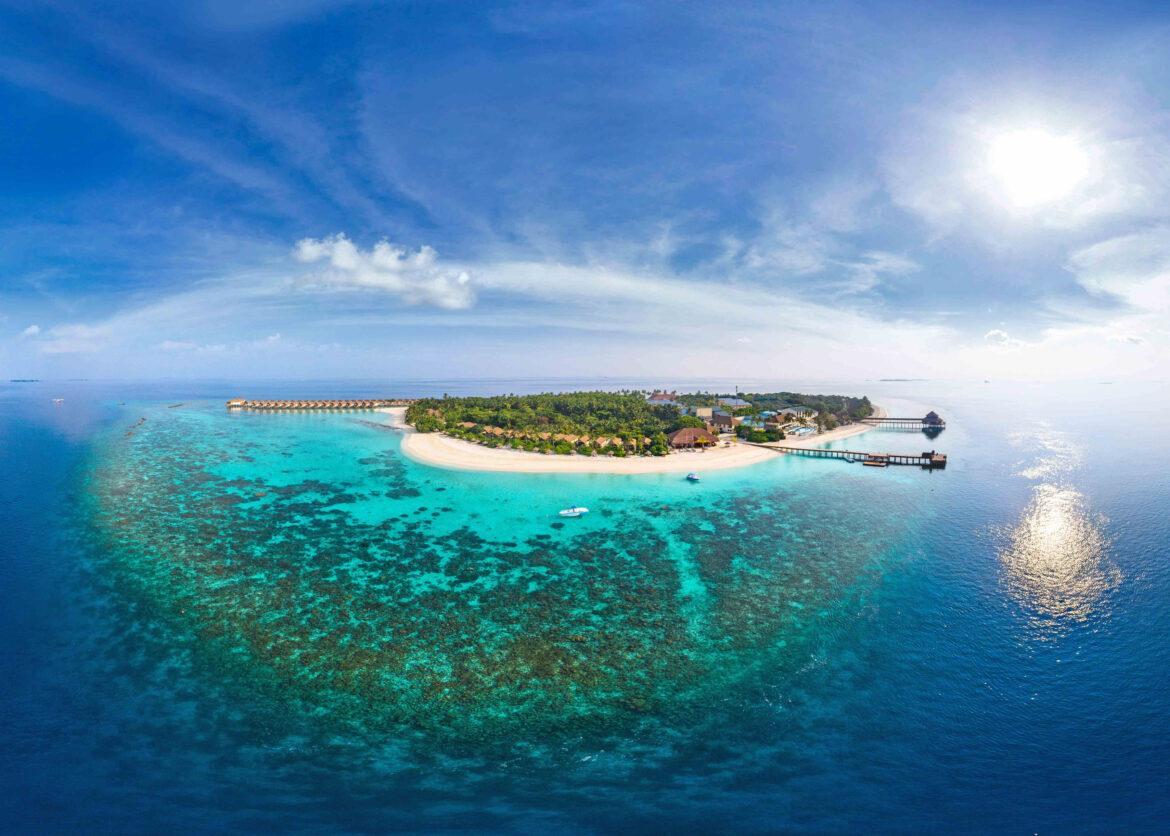
Dusk is approaching and dramatic clouds takeover the paradise sky – filled with shades of hope of a sustainable tomorrow! While cities around the globe are still adapting to the ‘new normal’, Maldives has been blissfully blessed to shelter the new wave of travellers into its safe haven. It is one of the most visually stunning destinations where shades of aquamarine blend seamlessly with the white sand amidst the tropical foliage. This unique blend has been drawing visitors for decades to explore its waterscapes and landscapes and the quintessential underwater magic. Taking the responsibility of maintaining that fine line of responsible tourism, many resorts across the region are including sustainable practices going forward.

One such eco-conscious resort, dedicated to the cause of sustainability is Reethi Faru Resort, translating to a beautiful reef in Dhivehi – the Maldivian language! A stunning bio- luxury resort on the secluded, private island of Filaidhoo, Reethi Faru has been dedicatedly working towards maintaining the perfect harmony between all the elements of nature – from marine life rehabilitation to planting of coral reefs, from incorporating the biggest solar panel installations to wastewater treatment plants. This resort is a forward-thinking establishment taking the right steps today to ensure that tourism and one of the world’s most fragile ecosystems can both coexist in harmonious sync with each other in days to come.

Established in 2017, its alluring 150 secluded hideaway villas are surrounded by breathtaking land and waterscapes. Their meticulously thought through a channel of construction, ensured that no trees are cut down during the course – the ones that had to be removed, were safely relocated to other parts of the island. The mobilization of machinery, which would harm corals in the lagoon was also avoided. While setting up the beams for the jetties and water villas, the corals were safely relocated within the house reef as was the case during the placement of wave breakers. To tackle the issues of beach erosion, wave-breakers have been placed in critical areas around the island.

Sustainable initiatives – recovering, growing and diversifying house reef

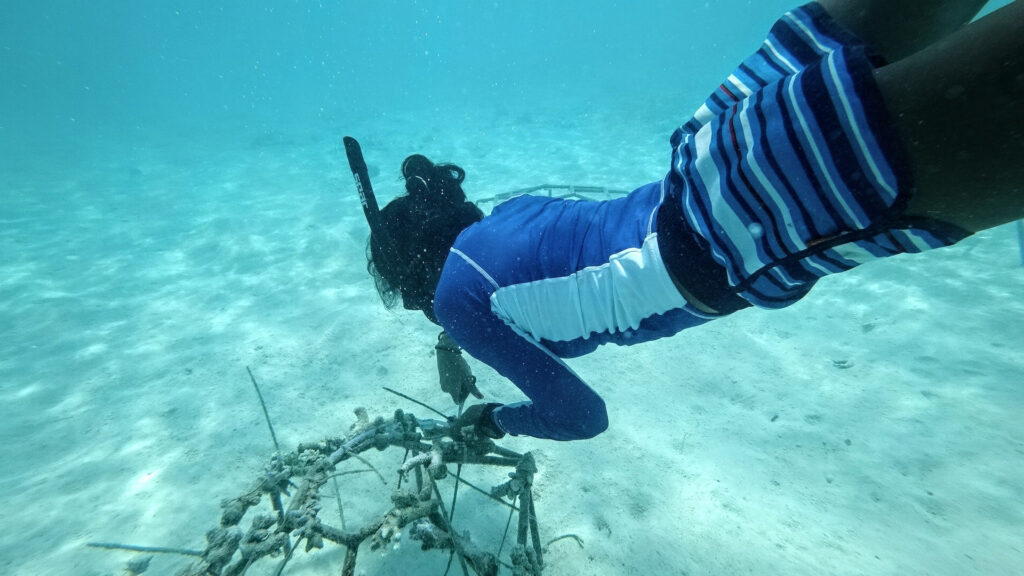
The island boasts of a charming lagoon, with its house reef just thirty to eighty meters from the shore. As an on-going mission to restore its house reef, ever since the development phase, the resort has conceived various methods and techniques, in sync with its marine biologist, towards coral growth and conservation, and continue to do so. Upon carefully observing the changes in the ecosystem, the resort team has been modifying and using techniques to create artificial reefs and transplant corals to coral nurseries. Coral nurseries and artificial reefs are forms of active reef restoration aimed at increasing coral health, diversity, and abundance.

“The impacts of climate change have been devastating on the coral reefs around the world. Therefore, it is imperative to focus on finding solutions to this problem. At Reethi Faru, we have been restoring the coral reef around the island using various methods – from creating artificial reefs using metal frames to rope nurseries, and also went one step further by setting up our very own land-based coral nursery. We hope that all these efforts, along with our ongoing sustainable initiatives for energy and waste management, will help us get back on track with protecting and conserving our natural environment.”

–Marine Biologist – Smrutica Jithendranath

The artificial reefs were established with the aim of salvaging corals that have been damaged by coral bleaching and natural storms. Accumulated in one area, these artificial reefs form a coral garden that has been given the name ‘Reethi Garden’. The transplantation process includes collecting broken or damaged pieces of live corals and attaching them to coral frames. This gives the corals a chance at survival and aids in the enhancement of existing reef habitats.

The team’s new goal is to increase and improve the diversity of the coral species in the reef. Resilient coral species that have overcome and survived the bleaching are being identified and categorized as either abundant or non-abundant species. Currently, the focus is on breeding and growing the non-abundant species in their coral nursery that will eventually be replanted in the natural reef.

Reethi Day: Celebrating and conserving the environment

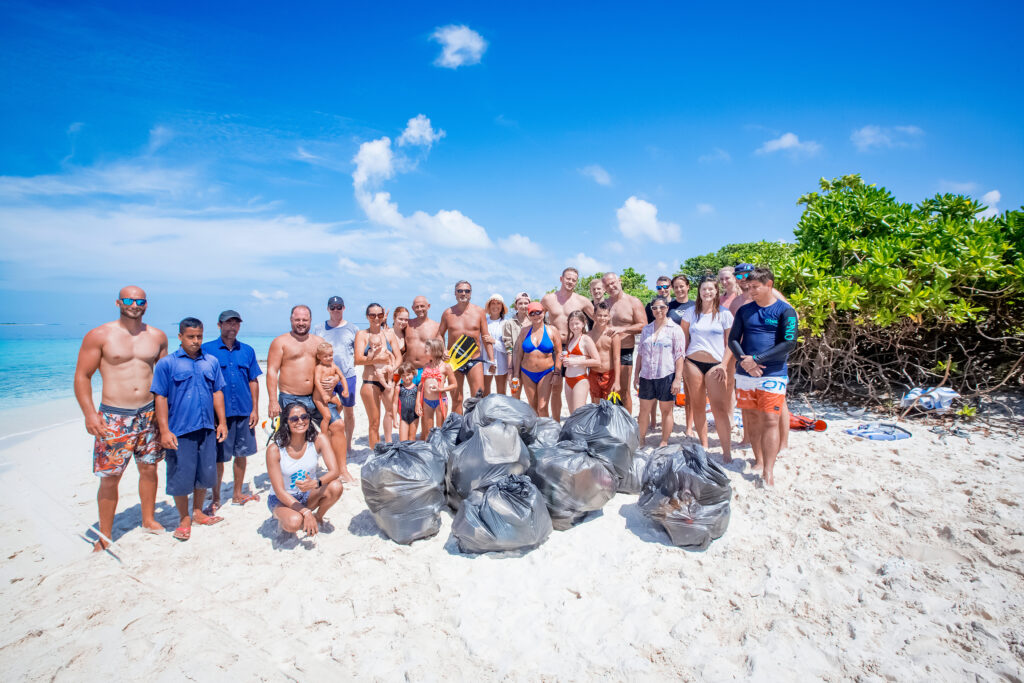
Mindful of protecting the environment, both marine and terrestrial, conceived their monthly event -Reethi Day (Beautiful Day in Dhivehi) – to celebrate the environment and help conserve it through education and activities. Interestingly, their in-house guests actively participate in coral planting, reef and beach clean-ups, tree plantation, educational presentations, guided awareness snorkels and more! Their Environmental and Marine Center serves towards marine research and plays the part of a useful educational tool to impart the importance of marine biology/ conservation.

It’s pretty safe to say that the one thing people around the globe have missed the most in the past year has been the opportunity to travel and discover new places. And it doesn’t come as a surprise that travellers are consciously opting for sustainable choices, to feel safer, and comfortable and in some sense giving back to the environment.

“We sleep better knowing that when we are wide awake, we are doing all that we can to care | contribute | conserve the world that we owe our very own existence to!”

Resort Manager – Vittoriano Ummarino

Sustainability at its core

The plush villas here demonstrate opulence right from the entrance, and what makes them more righteous is the core principles they are built upon. Constructed using a combination of soil stabilized earthen blocks and aerated cement blocks (made in-house) – both eco-friendly materials – functioning as natural heat insulators that help keep the carbon footprint as low as possible. This eco-conscious resort synonymous with sustainability – in principle and practice – boasts of six restaurants, six bars, an infinity pool, a sports complex and gym, a dive and watersports centre and a spa. Sheer seclusion and splendour are what you’ll get at this ultimate escape. With over 400 staff members, Reethi Faru has employees from diverse backgrounds and locals alike.

“A business must exist for a greater purpose than just shareholder returns – there lies a greater responsibility of respecting the land and its resources. From generating the highest capacity of solar power (1 megawatt) in the Maldives to producing our mineral water on-site – from producing fuel through biogas plant to using wastewater for irrigation – Reethi Faru Resort has implemented effective ways to conserve and protect the environment.”

-Director of Engineering – Kasi Rao Pothamchetty

At any given day 60%- 70% of the overall load of the island, during the day, is met by using solar energy, resulting in a reduction of carbon footprint significantly. The remaining electricity required is produced by state-of-the-art energy-efficient diesel generators fitted with a heat exchanger system that helps produce hot water for the entire resort, helping them avoid the use of electrical or gas boilers. Furthermore, they have 3 in-house RO Plants that desalinates seawater and converts it into freshwater.

Recycling Waste and banishing single-use plastic

Committed to reducing the impact of waste generated by their operations, Reethi Faru Resort has a dedicated waste segregation facility on its island. They strongly believe in implementing the 3R’s of waste management – Reduce, Reuse and Recycle – with a dedicated waste segregation facility on its island. All food waste generated in the resort is segregated and directed to their in-house biogas plant, which generates biogas from food waste, which is in turn used for cooking- thereby reducing the need for traditional, non-renewable cooking gas.

The resort is working towards managing and recycling plastic waste on the island, to avoid and intercept their entry into the marine ecosystems. Additionally, they have implemented the use of paper straws instead of plastic and switched from plastic bottles to glass bottles in all the guest areas. 99% of the lights around the island are LED as part of the resort’s conservation plan. The refrigerant gas used in refrigeration and air conditioning is eco-friendly which is free of CFCs. Electric bikes and carts are used to commute and baggage transfer within the island.

Accolades for its efforts

Reethi Faru Resort won the Indian Ocean’s Leading Green Resort 2020 award and was nominated for the World’s Leading Green Resort 2020 and Maldives’ Leading Green Resort category at the World Travel Awards 2020. Additionally, the resort became the proud winners in two categories – Luxury Eco Resort (Regional) and Luxury Spa Resort (Continent) – at the recently concluded World Luxury Awards.

Tourists want to get back in the air, employees want to return to business as usual, and families want a holiday. But the new normal is more ecologically aware, more responsible towards cause and effect, and more cautious. A single person or a standalone resort can start the journey towards sustainability, but a revolution takes people. And keeping that in mind Reethi Faru has been relentlessly promoting responsible tourism by creating ecotourists. With continuous direct engagement in various activities and a professional technical tour, guests at this resort get to soak in the sustainable and eco-friendly practices spread across the island.

March 29, 2021 0 comment
0 FacebookTwitterPinterestEmail
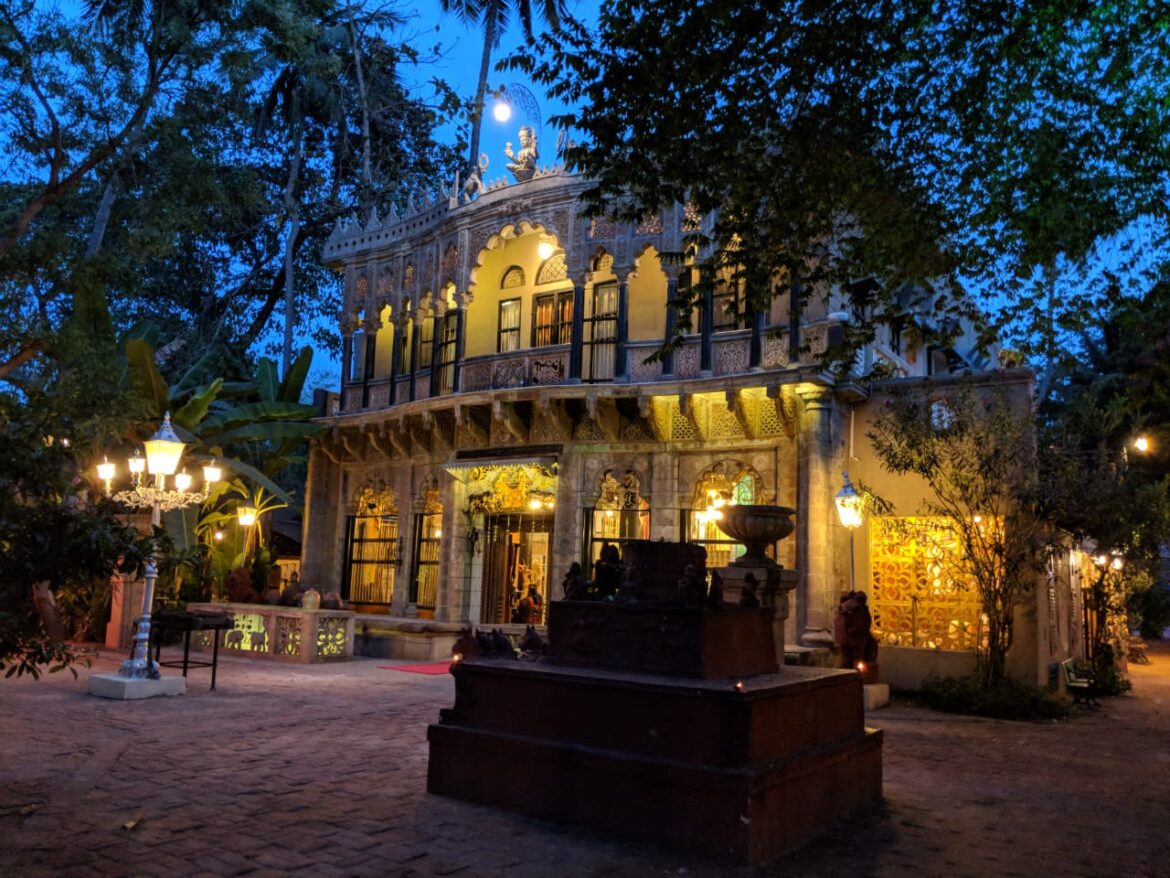
hotel in the evening with lights on
Travel

INDeco Hotels: A Pioneer of Sustainable & Rural Tourism in India

by Team Conscious Carma January 19, 2021
written by Team Conscious Carma

Can you believe that a sustainable and responsible hotels project in a remote rural region can change the fate of neighbouring villages and nearby towns?

The per capita income goes up from 5 odd US dollars per family per month to well over 400 US dollar. In a period of 10 years, happiness quotient goes up, NIL unemployment, finds a market for all village produce, all children go to school and the list goes on. Works with the local administration to make its town and railway station one of the cleanest. Treats 100% of its solid waste and above all has about 50 odd air-conditioned bus stops with ATM’s attached. All-girls schools have been provided with a toilet. Again, this list also goes on. The question is why we have not reproduced this model across the country?

The story of India’s first sustainable and rural tourism dates back to as early as 1992. A young man set out to revive Indian villages. After having worked globally at the UN, Government of India, Press, Films, Hotels and the Corporate, he bought a sick company in India, revived it and sold it to find the money to create these Rural Hotels. Being the hotelier wasn’t his business plan. It was his passion to work for the villages. The rural and urban inequalities causing total damage to the rural economy was his primary concern. This was followed by a chance meeting with the late Hindu pontiff Shankaracharya, who inspired him to follow his passion.

Sustainable hotel

He set out to establish big, responsible, sustainable and regenerative tourism businesses in remote rural and tribal pockets of Tamilnadu to mend their broken backbone. The person acquired three abandoned dilapidated historic villages in SWAMIMALAI near Tanjore. He redefined Hospitality from being a mere shelter to development, protection and preservation. All with what the local people know have and do. And in the process preserve their art, heritage, culture, livelihood, antiquities, flora, fauna, lifestyle, ecology, technologies, tradition, skills, traditional cuisine & sustainable practices.

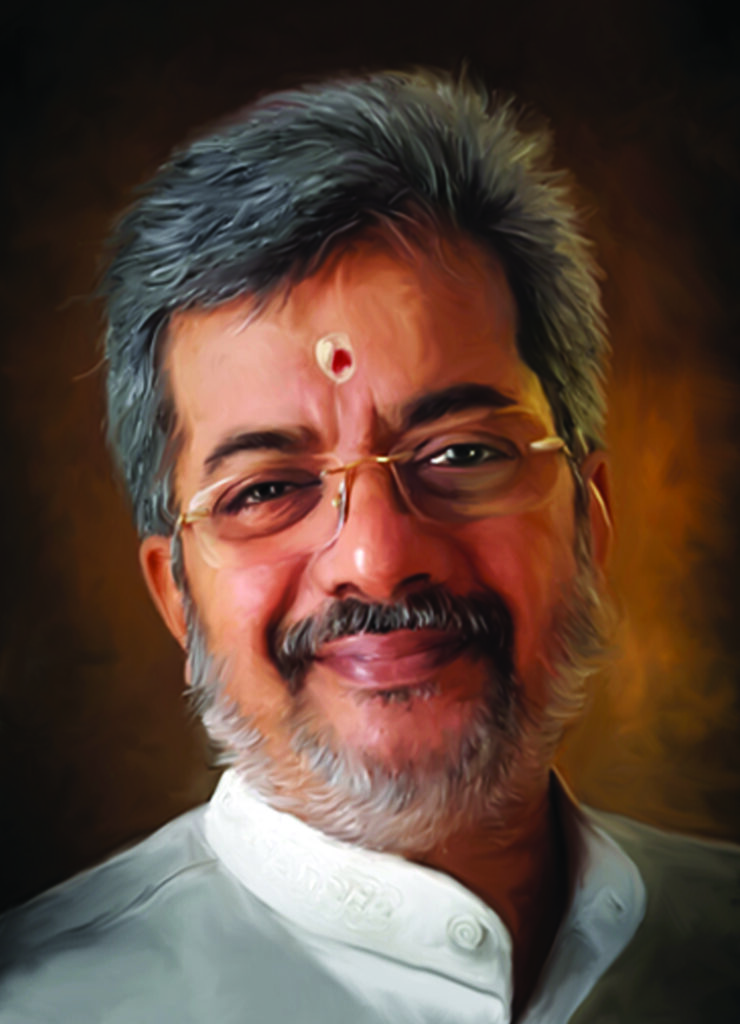
The destiny changed not only for him but also for the villages and the town around. Wherever he established businesses, Per capita income increased from less than USD5 to USD 400 per family per month. In addition, the happiness quotient went up and attained high employment, hygiene and sanitization levels. Today, the man STEVE BORGIA is India’s pioneer in rural tourism.

Steve borgia man smiling

Steve is one of the founders of the Ecotourism Society of India (ESOI) which is now the Responsible Tourism Society of India (RTSOI). He’s also the Vice President of the Indian Heritage Hotels Association (IHHA). He is the founder chairman of Association of Agri & Rural Tourism Society of India (AARTI) and several smaller travel and tourism organisations.

His unique properties are as follows:
  1. INDeco Hotels Swamimalai, in Kumbakonam, Tanjore District, S.India established in 1992. India’s unique Heritage Hotel.
  2. INDeco Hotels, Mahabalipuram was established in 2003 to create job opportunities for the fisherman communities around.
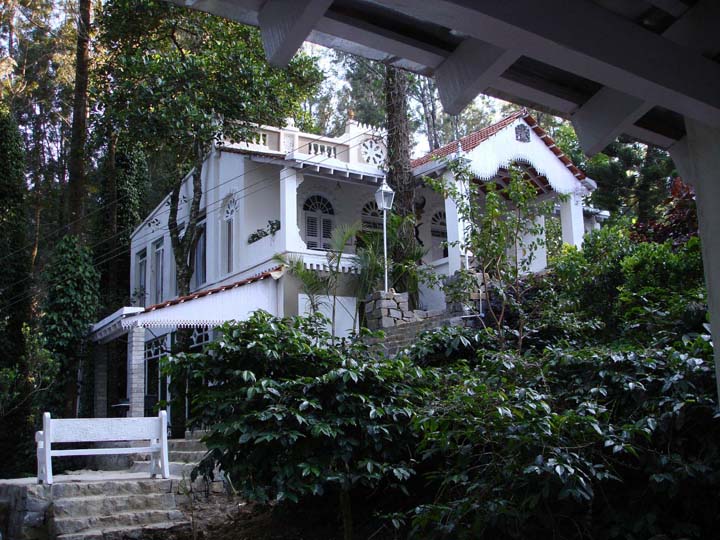
  3. INDeco’s Lake Forest Hotel was created in 2007 with 100 rooms amidst coffee plantation without damaging the ecology.

Kumbakonam today is the cleanest town in India. Its Railway station is one of the best kept Railway Station. No beggars in the town, 100% solid waste is treated, the cost of electricity is 10 % less than the rest of the country. All girl schools are provided with toilets; the only town in India which has airconditioned bus Stops with ATMs attached.

Another very interesting feature of INDeco hotels is that each of these properties houses a Museum.

“The Indian heritage museum is the soul of INDeco Hotels. These museums contain very pristine objects right from the World’s smallest gramophone to the first aircraft that landed at the Madras presidency. The Gate of Madras Central prison, the prison cell in which Subhash Chandra Bose was kept overnight before being moved to the cellular jail, very interesting objects which the British brought from England and left behind. The museums are very interactive as we encourage some objects being touched and operated by the visitors. We are lucky to be in historical space, therefore it serves the very purpose of the museum”

says Steve.

Fortune magazine awarded INDeco Hotels as the 6th best idea to save planet earth minuscule all the other national and international awards bestowed.

“Steve, the creator of this facility is the Viswakarma in building heavenly resorts. This is what we must expose to the Western World. I like the way INDeco cares for insects, birds& animals, protects heritage, promote culture, work with local people with what they know, have and do. This is a workable model for the nation to develop our villages, It is truly overwhelming to know that this hotel project has had such an impact in the neighbourhood. I feel I am in a village and not in a hotel.”

This is what a Former Indian Prime Minister had to say…

Steve is now all set to take sustainable rural tourism to the next level. He is now in the process of creating a world wonder THE LAST RESORT for human wonderment and the ecoVILLE. a sustainable village for earth-loving people in the Kodai foothills near Palani in Tamilnadu.

Thanks to CORONA, the world will now be moving to sustainable, rural and responsible tourism products. And this shift will quickly be on the upward trend as it is across the globe. Today people want to go to natural spaces where there is not much of human intervention.

sustainable hotel room

On being asked, why have we not reproduced this model across the Country, Steve says, “These things like Museum, ecology are all the end products of very passionate people, govt can support in terms of tax benefits and subsidies. But passionate entrepreneurs need to take charge to reproduce this model. One has to be innocently brave, logically sane, shamefully courageous, dream big and achieve their dreams passionately. I am very hopeful of the younger generation to follow my footsteps as I see a lot of compassion, care for earth and sustainability among youngsters. I strongly believe that more and more young people will do responsible businesses and not polluting businesses. You will not find somebody put up a cement factory in a remote rural area, as my generation did.”

I just have one piece of advice for the Tourists in general who desire to holiday in Rural Areas. “if you go to villages, you need to be highly responsible, if you cannot give back to the rural community, don’t go there. You must offer benefit to the local community otherwise you are not being fair. Also, I request young people from rural areas, who go to urban cities for education to come back to your villages, revive them, regenerate them, and take care of your people. Believe me, you are going to be the winners and not the ones scaling heights in the share market.”

The government on the other hand should create policies that support such activities by entrepreneurs, maybe some tax cuts, electricity subsidies, etc. To build a hotel in a remote area or a hill station is twice as expensive as building it in the city. The government should consider this seriously as this could really give a boost to sustainable and rural tourism and make the villages self-sufficient.

There is no other country in the world that is as rich as India when it comes to Tourism. We have everything, from North to South, East to West, we have so many countries and cultures packed in India. In fact, we are the only country that can sell emotion in the whole world. If India needs to smile longer, we need to act now, the hour is now.

To checkout more articles from out magazine, Click here

Checkout Other latest posts from Conscious Carma:

  • India–UK Free Trade Agreement Opens Global Growth Opportunities for 3R ZeroWaste’s Circular Economy Solutions
  • Plastic Free July: Why True Sustainability Goes Beyond Swapping Plastic
  • From the Editor’s Desk: When Greed Takes Over Conscience
  • Beyond the Pose: Why Your Yoga Mat Needs a Sustainable Upgrade
  • Best Sustainable Father’s Day Gifts: Conscious Carma’s Exclusive Picks
January 19, 2021 0 comment
0 FacebookTwitterPinterestEmail
hotel in the evening with lights on
Travel

Pioneer of Sustainable & Rural Tourism in India

by Team Conscious Carma December 16, 2020
written by Team Conscious Carma

INDeco Hotels

Can you believe that a sustainable and responsible hotel project in a remote rural region can change the fate of neighboring villages and nearby towns?

The per capita income goes up from 5 odd US dollars per family per month to well over 400 US dollars in a period of 10 years, happiness quotient goes up, NIL unemployment, finds a market for all village produce, all children go to school and the list goes on. Works with the local administration to make its town and railway station one of the cleanest, treats 100% of its solid waste and above all has about 50 odd air-conditioned bus stops with ATM’s attached, all-girls schools have been provided with a toilet. Again, this list also goes on.

The question is why we have not reproduced this model across the Country.

The story of India’s first sustainable and rural tourism dates back to as early as 1992 when a young man set out to revive Indian villages. After having worked globally at the UN, Government of India, Press, Films, Hotels and the Corporate, he bought a sick company in India, revived it and sold it to find the money to create these Rural Hotels. Being the hotelier wasn’t his business plan. It was his passion to work for the villages. The rural and urban inequalities causing total damage to the rural economy was his primary concern. This was followed by a chance meeting with the late Hindu pontiff Shankaracharya, who inspired him to follow
his passion.

He set out to establish big, responsible, sustainable and regenerative tourism businesses in remote rural and tribal pockets of Tamilnadu to mend their broken backbone. He acquired three abandoned dilapidated historic villages in SWAMIMALAI near Tanjore. He redefined Hospitality from being a mere shelter to development, protection and preservation. All with what the local people know have and do. And in the process preserve their art, heritage, culture, livelihood, antiquities, flora, fauna, lifestyle, ecology, technologies, tradition, skills, traditional cuisine & sustainable practices.

The destiny changed not only for him but also for the villages and the town around. Wherever he established businesses, Per capita income increased from less than USD5 to USD 400 per family per month and the happiness quotient went up and attained high employment, hygiene and sanitization levels. Today, the man STEVE BORGIA is India’s pioneer in rural tourism.

Steve is one of the founders of the Ecotourism Society of India (ESOI) which is now the Responsible Tourism Society of India (RTSOI). He’s also the Vice President of the Indian Heritage Hotels Association (IHHA). He is the founder chairman of Association of Agri
& Rural Tourism Society of India (AARTI) and several smaller travel and tourism organisations.

England and left behind. The museums are very interactive as we encourage some objects being touched and operated by the visitors. We are lucky to be in historical space, therefore it serves the very purpose of the museum”, says Steve.

Fortune magazine awarded INDeco Hotels as the 6th best idea to save planet earth minuscule all the other
national and international awards bestowed.

Here is what a Former Indian Prime Minister had to say…
“Steve, the creator of this facility is the Viswakarma in building heavenly resorts. This is what we must
expose to the Western World. I like the way INDeco cares for insects, birds& animals, protects heritage,
promote culture, work with local people with what they know, have and do. This is a workable model for
the nation to develop our villages, It is truly overwhelming to know that this hotel project has had
such an impact in the neighbourhood. I feel I am in a village and not in a hotel.”

Steve is now all set to take sustainable rural tourism to the next level. He is now in the process of creating
a world wonder THE LAST RESORT for human wonderment and the ecoVILLE. a sustainable village for earth-loving people in the Kodai foothills near Palani in Tamilnadu.

Thanks to CORONA, the world will now be moving to sustainable, rural and responsible tourism products. And this shift will quickly be on the upward trend as it is across the globe. Today people want to go to
natural spaces where there is not much of human intervention.

On being asked, why have we not reproduced this model across the Country, Steve says, “These things like Museum, ecology are all the end products of very passionate people, govt can support in terms of tax benefits and subsidies. But passionate entrepreneurs need to take charge to reproduce this model. One has to be innocently brave, logically sane, shamefully courageous, dream big and achieve their dreams passionately. I am very hopeful of the younger generation to follow my footsteps as I see a lot of compassion, care for earth and sustainability among youngsters. I strongly believe that more and more young people will do responsible businesses and not polluting businesses. You will not find somebody put up a cement factory in a remote rural area, as my generation did.”

I just have one piece of advice for the Tourists in general who desire to holiday in Rural Areas. “if you go to villages, you need to be highly responsible, if you cannot give back to the rural community, don’t go there. You must offer benefit to the local community otherwise you are not being fair. Also, I request young people from rural areas, who go to urban cities for education to come back to your villages, revive them, regenerate them, and take care of your people. Believe me, you are going to be the winners and not the ones scaling heights in the share market.”

The government on the other hand should create policies that support such activities by entrepreneurs, maybe some tax cuts, electricity subsidies, etc. To build a hotel in a remote area or a hill station is twice as expensive as building it in the city. The government should consider this seriously as this could really give a boost to sustainable and rural tourism and make the villages self-sufficient.

There is no other country in the world that is as rich as India when it comes to Tourism. We have everything, from North to South, East to West, we have so many countries and cultures packed in India. In fact, we are the only country that can sell emotion in the whole world. If India needs to smile longer, we need to act now, the hour is now.

December 16, 2020 0 comment
2 FacebookTwitterPinterestEmail
Travel

Inspiring stories from Philanthropic & CSR World

by Team Conscious Carma December 16, 2020
written by Team Conscious Carma

AZIM PREMJI, INDIAN BUSINESS TYCOON

The most generous Indian

Wipro’s Azim Premji emerges as the most generous Indian in FY20. India’s IT major Wipro’s Azim Premji donated Rs 22 crore a day or Rs 7,904 crore in a year to emerge as the most generous Indian in FY20 and top a list of philanthropy.

An Indian business tycoon, investor, engineer, philanthropist and founder of one of India’s finest companies, admired globally for its uncompromising ethics and best practices in business, Azim Hashim
Premji is informally known as the Czar of the Indian IT Industry.

For a man who gives away Rs.22 crores of his wealth every day to improve elementary education in the country, Azim Premji, has been an enigma.

RAVI KALRA, EARTH SAVIOURS FOUNDATION

A home away from home

Earth Saviours Foundation (ESF), also called
Gurukul is home to around 450 homeless people, including over 300 mentally-challenged persons.

Founded in 2008 by Ravi Kalra, 49, who was moved to see a beggar child scouring garbage along with street dogs on a busy Delhi road. With all the money he had, he started his foundation and, since then, has dedicated himself to improving the lives of abandoned senior citizens, physically and mentally disabled, victimised women, and people suffering from incurable diseases. “I feel all of them deserve to live with dignity,” he said. The Earth Saviours Foundation runs without any government support, doesn’t have enough beds for the 450 people who reside there, but always has its doors open for the homeless.

An astonishing fact, Kalra has come across beggars who are NRIs, retired army officers, IAS officers who were abandoned by their families in old age.

FARHAN PETTIWALA, AKHAND JYOTI EYE HOSPITAL

Passion to serve

All of 48, Farhan has a distinguished 27-year long career as a serial entrepreneur, a senior corporate executive with MNCs in India, Australia, UAE, Singapore and has been engaged in running for-profit and not-for-profit social organization.

His excellent relations, both in the government and with corporate leaders are testimony of the fact that he has been instrumental in raising donations of over Rs.50 crore every year for the wonderful work done by a little-known organization in the remote Mastichak village in Bihar, Akhand Jyoti Eye Hospital (AJEH), working towards eliminating curable blindness from poorer states like Bihar, and Eastern U.P. and empowering women through “Football to Eyeball” girl education and development program.

Now looking at getting back to the mainstream as a CEO using his experience in both sectors, Farhan has been recognized by The Honourable Prime Minister of India and The President of India as the emerging Business leader of the year. Farhan currently serves as an Honorary Advisor to the Prime Minister of India (PMO).


ANSHU GUPTA, GOONJ

True giving always respects and preserves human  dignity

Anshu Gupta, popularly known as the Clothing Man is the Founder of an Indian based nonprofit – Goonj. One of India’s leading social entrepreneurs, Anshu left a corporate job in 1998 and founded
GOONJ with a mission to make clothing a matter of concern and to bring it among the list of subjects for the development sector. Anshu is creating a mass movement for recycling and reuse of tonnes of waste material by channelising it from the cities
to the villages, as a resource for rural development.


Anshu brings to the table an instinctive empathy and connects with people, moving the focus from the conventional – giver’s pride to the unconventional – receiver’s dignity.

Asia’s Noble, the prestigious Ramon Magsaysay award 2015, conferred to him credited him for ‘his creative vision in transforming the culture of giving in India, his enterprising leadership in treating cloth as a sustainable development resource for the poor, and in reminding the world that true giving always respects and preserves human dignity.


December 16, 2020 0 comment
1 FacebookTwitterPinterestEmail
Newer Posts
Older Posts

Recent Posts

  • India–UK Free Trade Agreement Opens Global Growth Opportunities for 3R ZeroWaste’s Circular Economy Solutions
  • Plastic Free July: Why True Sustainability Goes Beyond Swapping Plastic
  • From the Editor’s Desk: When Greed Takes Over Conscience
  • Beyond the Pose: Why Your Yoga Mat Needs a Sustainable Upgrade
  • Best Sustainable Father’s Day Gifts: Conscious Carma’s Exclusive Picks

Recent Comments

  • Team Conscious Carma on Label Shivika Agarwal – where craft meets sustainability
  • Cocomeister.jp on Label Shivika Agarwal – where craft meets sustainability
  • Team Conscious Carma on Equitable City Designs To Fight Climate Change
  • UN report calls for repurposing of USD 470 billion of agricultural support that distorts prices and steer us away from environment and social goals | Consciouscarma on UNEP & ICMR collaborate to boost understanding of environmental dimensions of antimicrobial resistance in India
  • Wild Earth : Natural body products | Consciouscarma on Sat.Suma : the true essence of flowers in your everyday skincare needs

Keep in touch

Facebook Twitter Instagram Youtube

Recent Posts

  • India–UK Free Trade Agreement Opens Global Growth Opportunities for 3R ZeroWaste’s Circular Economy Solutions

  • Plastic Free July: Why True Sustainability Goes Beyond Swapping Plastic

  • From the Editor’s Desk: When Greed Takes Over Conscience

  • Beyond the Pose: Why Your Yoga Mat Needs a Sustainable Upgrade

  • Best Sustainable Father’s Day Gifts: Conscious Carma’s Exclusive Picks

  • How Sacred Sound is Reshaping the Future of Holistic Health?

Categories

  • Community (38)
    • Campaigns (3)
  • CSR (4)
  • Economy (82)
    • Global (24)
    • Industry (42)
    • Innovations (4)
    • National (2)
  • Environment (48)
  • Expert Corner (48)
    • Authored Articles (47)
  • Featured (5)
    • Partners (1)
  • Global News (2)
  • Initiatives (31)
    • CSR (3)
    • Events (6)
  • Inspiration (22)
  • Lifestyle (9)
  • Media Coverage (6)
  • Press Releases (4,358)
  • Products (126)
    • Accessories (27)
    • Apparel (32)
    • Beauty (26)
    • Food (4)
    • Gifting (3)
    • Home Décor (15)
    • Skin-Care (14)
  • Reports (3)
  • Spirituality (10)
  • Sustainability (49)
  • Sustainable Startup Stories (28)
  • Travel (19)
  • Uncategorized (2)
  • Wellness (33)
    • Home Cleaners (3)

Archives

  • August 2026 (1)
  • July 2026 (1)
  • June 2026 (6)
  • October 2024 (1)
  • September 2024 (1)
  • July 2024 (2)
  • June 2024 (2)
  • May 2024 (1)
  • November 2023 (330)
  • October 2023 (554)
  • September 2023 (631)
  • August 2023 (718)
  • July 2023 (723)
  • June 2023 (710)
  • May 2023 (608)
  • April 2023 (114)
  • March 2023 (7)
  • February 2023 (3)
  • January 2023 (11)
  • December 2022 (18)
  • November 2022 (1)
  • August 2022 (6)
  • July 2022 (8)
  • June 2022 (24)
  • May 2022 (11)
  • April 2022 (19)
  • March 2022 (11)
  • February 2022 (11)
  • January 2022 (14)
  • December 2021 (10)
  • November 2021 (4)
  • October 2021 (14)
  • September 2021 (22)
  • August 2021 (12)
  • July 2021 (17)
  • June 2021 (17)
  • May 2021 (16)
  • April 2021 (22)
  • March 2021 (33)
  • February 2021 (16)
  • January 2021 (22)
  • December 2020 (10)
  • Facebook
  • Twitter
  • Instagram
  • Pinterest
  • Linkedin
  • Youtube

@2020 - All Right Reserved. Designed and Developed by Bizopser Technologies

Consciouscarma
  • Home
  • About Us
  • Products
  • Community
    • Campaigns
    • Inspiration
    • Initiatives
    • CSR
  • Features
    • Sustainable Startup Stories
    • Travel
    • Lifestyle
    • Partners
  • Economy
    • Industry
    • Innovations
    • National
    • Global
  • Environment
  • Expert Corner
    • Authored Articles
    • Reports
  • Magazine
  • Contact